
The transformation in how we understand spirituality and religion is gradually becoming mainstream.
At the core of this cultural revolution are two key ideas.
The first is that today everyone has access to all the world’s religions and spiritualities. In this new context of global knowledge and diversity, the claim that a particular religion or spiritual tradition is the one and only truth is improbable and, at worst, dangerous. Spirituality, like all things in nature, is varied.
The second key concept is that spiritual experience is not intellectual. It is a felt and embodied experience. The magic and mystery of life (‘God’) speaks to us through feelings — feelings which our mind-brain then seeks to interpret and understand.
For decades now, inspired by the mystics of all traditions, we in the Spiritual Companions Trust have been developing educational resources that seek to make spiritual experience accessible to everyone. This approach always begins with one person-centred enquiry:
In what circumstances do you most easily experience the magic and wonder of life?
We then listen very carefully to how the individual responds to that enquiry. We validate their experience. There is an extraordinary beauty and blessing when someone has that ah-ha moment of recognising and validating their own particular way of spiritual experience. (In my last blog I wrote about a friend who experiences deep spiritual states when working on complex spreadsheets.)
As well as the diverse circumstances, we also make sure that people appreciate the variability of spiritual experience. Sometimes it is brief and shallow, as we catch an aroma or a pattern or a smile that touches our hearts. Other times, it can be deep, long and ecstatic. This often leads to other ah-ha moments as people recognise and value their small moments of magic and wonder; not just the bells and whistles of a full blown epiphany.
In recent months, working on the National Schools Spiritual Wellbeing Project, I have been reading many books and papers on children’s spirituality, exploring how our approach for adults might also work for children; and how it can also support teachers.
My thinking became puzzled as I reflected on how a sense of wonder might be recognised by a six-year-old. The concepts of wonder and awe are too hifalutin for young children. How could it be successfully communicated?
My daughter, Sophie, a primary school teacher, said it would be easy. She created a character called Sparkle, who represents wonder and awe for children.
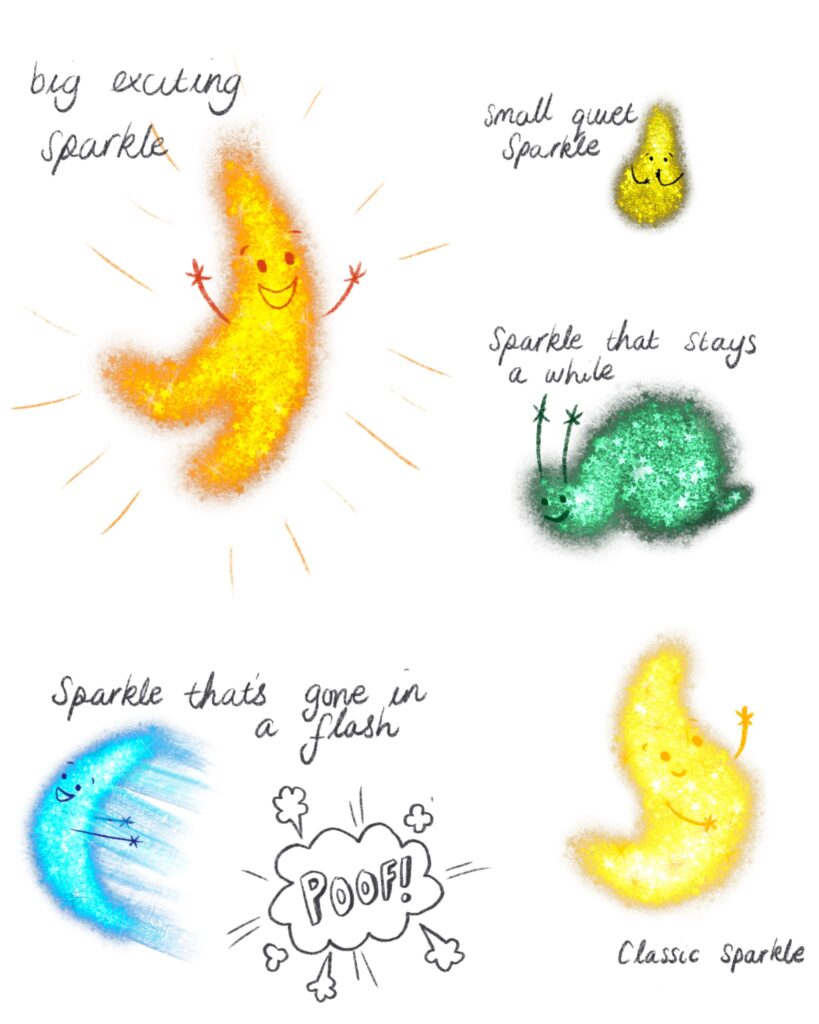
At the same time, in my research I came across a very insightful model of spiritual experience in a paper by Tobin Hart*. He suggested that spiritual experience could be usefully characterised in four different ways. These ways are:
- Wonder
- Wondering
- Wisdom
- Relational empathy, which I prefer to label Love & Compassion.
This quartet can be unpacked and explored in many ways and in detail. Here are a few brief attempts.
Wonder
Awe. Beauty. The magic of life. This is the obvious bedrock of spiritual experience, when our sense of being alive expands to a dimension that is far greater than the usual mundane human experience. As I wrote above, it comes in diverse circumstances and variable depths — from a momentary heart-felt response through to a cosmic epiphany.
Wondering
How wonderful it is to recognise that wondering is also part of the spiritual experience. It is that soft sense of curiosity and enquiry into the great questions. Why do we exist? Who made the Sun? What is time? How can infinity go on and on? What is Love? What is Jesus? Who am I?
This kind of wondering is innocent and pure. It is comfortable with unknowing and mystery, yet instinctively expands. Its mood is beautifully illustrated by the mystic insight: The more I know, the less I know.
Wisdom
By wisdom, we mean here those wise and compassionate insights and intuitions that seem to come from nowhere. Suddenly we may know something that helps us to understand a situation in a wiser and more loving way. These insights drop into us from what the Indian sage, Patanjali, called ‘ the rain cloud of knowable things.’ We often see this wisdom and insight manifesting in children.
Love & Compassion
For many of us this is the deepest and most meaningful aspect of spiritual experience. It happens when we experience our inner relationship and solidarity with another, and have compassion and care for them. Children often do this when they see another child who is hurt or bullied. They do it too with animals and plants. Our egos expand to include something else inside the usual boundaries of our self-concern. We recognise our rapport with all sentient beings. It is ultimately a sense of oneness, that is expressed through caring and love.
Those four attributes of spiritual experience are obvious, but rarely made explicit. I find the naming of them to be profoundly helpful. They expand how I understand my own development.
They also reinforce our guidelines for how best we can support someone else’s spiritual development, whether they are a child or an adult.
As always, when spiritually companioning another, our core strategy, without exception, is to drop into whole body listening: Be quiet. Reassuring. Non-intrusive body language. Eyes soft and watchful. Ears receptive. Be a benevolent presence. Allow the other person to just be with themselves.
Then, if it feels appropriate, with spiritually pure curiosity, you can ask questions that support your companion, adult or child, in exploring their experience – in wondering about the wonder.
And listening from your heart, you yourself can also learn and grow.
Spiritual Experience:
• Wonder
• Wondering
• Wisdom
• Love and Compassion
Tobin Hart. 2005. ‘Spiritual Experiences and Capacities of Children and Youth,’ The Handbook of Spiritual Development in Childhood and Adolescence, pp 163–177. Eds: Eugene C. Roehlkepartain, Pamela E. King, Linda Wagener, & Peter L. Benson, CA: SAGE.